The question 'how many solar panels do I need' will actually depend on what you want to achieve, for example:
That determines what you need. Whether you can have that is a different question entirely, and will depend on:
So, we could say something basic like 'you will need between 6 and 16 panels which is typical for a UK home'. It's also probably what you read when you search on ChatGPT, Gemini, ask Claude, or whatever. Pah.
That kind of range is also unhelpful.
Let's say a typical panel is 450Wp. When the sun is blaring down on it, and it's south facing, and it's nice and clean, it'll generate 450W of power. Let's say too that you had room for 10 of them, then they would jointly deliver 4.5kW of instantaneous power. Let's then say that sun shone for 2 hours before dark storm clouds brewed and the sun was blocked out. For two hours your panels knocked out 4.5kW, and therefore you generated 2 x 4.5 = 9kWh. Now we're talking kWh, and therefore energy, not power.
Over the course of an average year depending where you are (north = less because of latitude and the way the earth rotates and moves round the sun, south = more for the same reasons) each 1kW of solar panels (photovoltaic or PV panels more accurately) will generate around 900kWh. So in the example above, where we have 4.5kW, typical generation will be about 4.5 x 900 = about 4,000kWh.
Moreover, average energy demand in a gas heated UK home is about 3,500kWh. So - and indeed boom! - you're now generating more than you need, right?
Sort of. The problem is you won't necessarily (in fact you won't at all) use it all when it's generating. If you don't use it, you either export it - which can be a nice little earner too, on the right tariff - or you store it in a battery for when you do need it. We don't cover battery sizing here, we'll sort that another time.
So get your energy bills out, or look at that energy supplier app, and see how much you use each year. If you want to reduce it by 50%, or 75% or even 100%, look at it over the course of a year and you can do the maths using the details above. Rule of thumb - 3,500kWh will need about 8 or 9 panels sized at 450Wp to generate the same amount of electricity you would use if you have a gas (or oil, or LPG) boiler.
This gets a bit more complicated. If you used everything you generate in our example above, and you used it all without exporting, paid 25p per kWh, then you would save 4,000kWh x £0.25 = £1,000.
BUT assuming like most people you would use about 60% of what you generated, and (say) earned 10p for every kWh you exported, then you would save:
Now if you had a battery, and sized it correctly you might store most of what you would otherwise export. Great, you're back to £1,000, but you've also paid for a battery too.
You'll be more independent the more PV you install, the more you can store with a battery, and therefore the less you import. It's sort of a corollary of the others. But we would also suggest you add some 'islanding' kit when you install them. Why? So that if there is a power kit, the system will continue to operate. Without that, there is an auto shut off in any PV system when there's a power cut, so your generated electricity won't accidentally electrocute Brian, the chap from the network fixing the wires out on the street.
It's still a thing, reducing carbon. Super important in fact. But it's not very often the ONLY driver of having PV installed. Even so, there's a simple calculation you can do which will give you a rough idea of what you'll save.
The actual figure varies depending on the energy mix in the UK at any moment - how much gas, nuclear, renewables etc are used to generate our electricity. As renewables increase, that number will drop over time. So by 2050 your PV - in theory - shouldn't be offsetting any carbon dioxide at all.
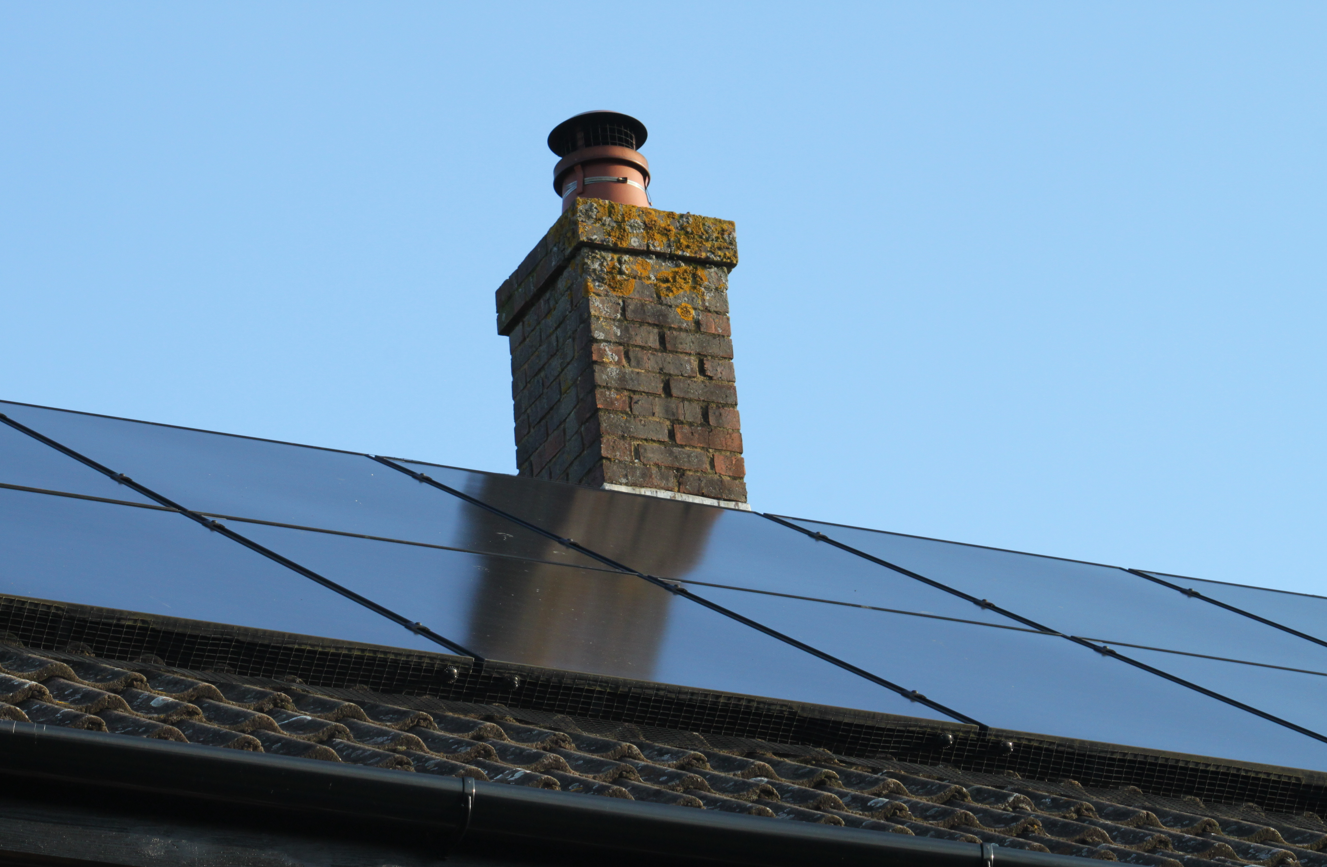
A solar panel is around 2m long by 1m tall. They need a clear roof space, and bear in mind you'll need to add fixings, and allow for flashings top, bottom and on the sides to make sure your roof remains waterproof.
We've provided an easy and quick calculator on our homepage which you can use, but the best and most accurate thing to do is get a survey done. If you want us to have a remote look at your home using maps, WhatsApp us on 07868 789624 and we'll get onto it free of charge.
If you're in a flat, sorry, it's a lot more tricky, although the government is currently looking into plug in panels, which makes it a little easier. If that happens, we'll update this article with more details.
Yeah, probably between 6 and 16 panels, depending on your roof space. Thank you, SEO.
Just get some, they're great, and they're worth the investment. Click the big orange button to get started, and we'll make sure you get a high quality, good value and reliable installation that'll save you money for 25 years or more.
Before you set up your account and continue your journey to a futureproofed home, just follow the links.