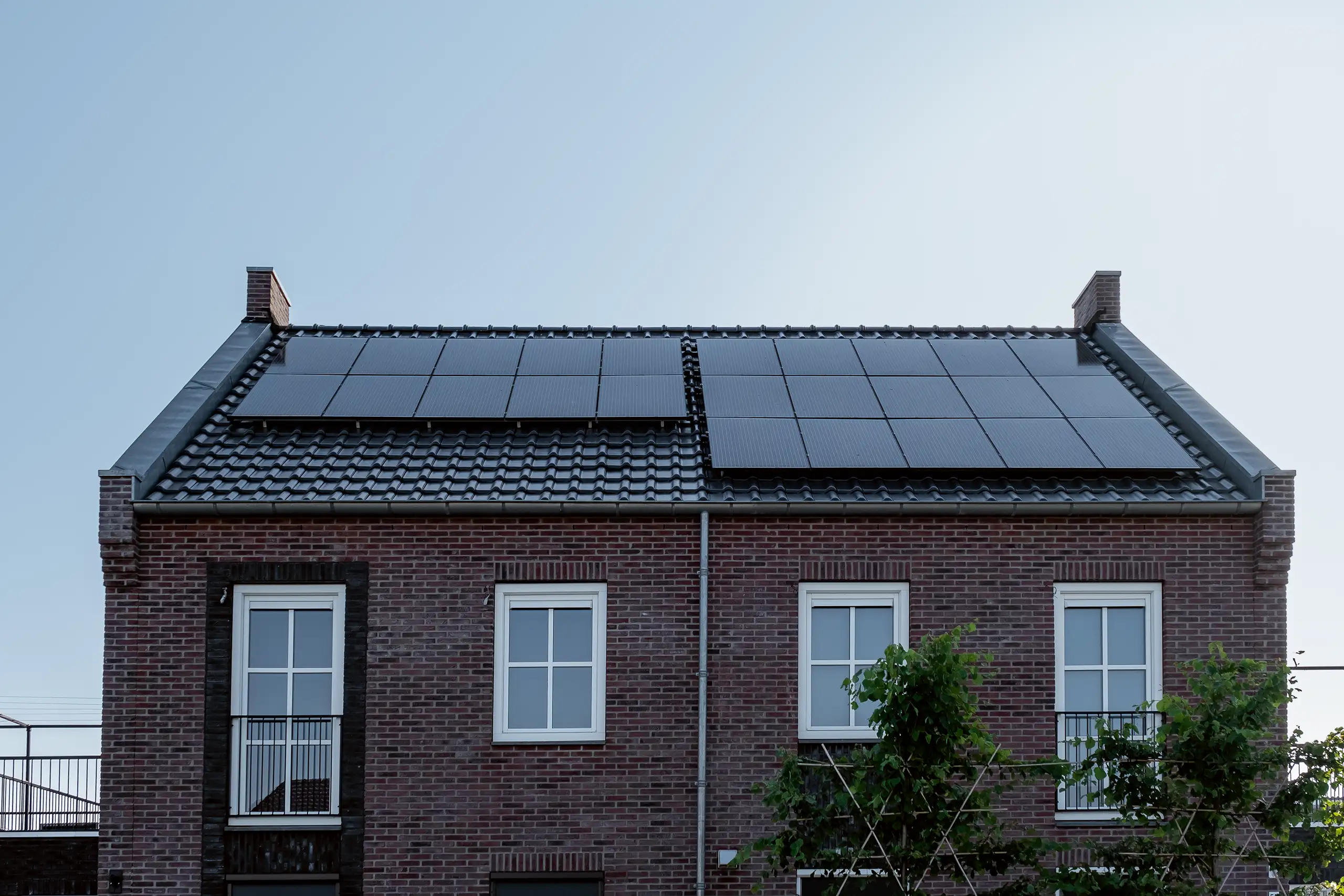
Facing south allows the panels to capture the most sunlight throughout the day as the sun moves from east to west across the southern sky.
South-facing solar panels therefore tend to produce the highest energy output year-round. However, if a south-facing roof isn’t available, don’t worry, you don’t need to move just yet! Panels facing south-east or south-west will still perform very well. Moreover, having panels on both east AND west-facing roofs can be very effective with only a slight drop in efficiency, with the added benefit of smoothing output over the day.
When it comes to the best angle for solar panels, orientation is only half the story. The tilt angle (or the vertical angle at which the panels are mounted) has a major impact on performance.
In the UK, the optimum angle for solar panels is typically between 30° and 40°. This allows them to absorb the most sunlight, especially during spring and autumn when the sun is at a moderate height in the sky. A 35° tilt, facing due south, provides a great balance for year-round energy generation.
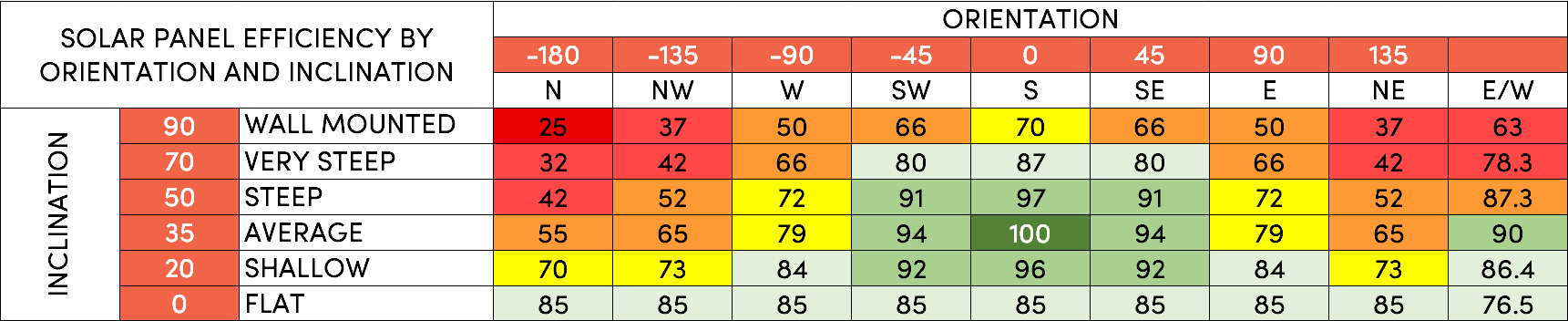
On pitched roofs, the angle is determined by the roof’s slope. However, if you’re installing on a flat roof or the ground, mounting systems can be adjusted to achieve the optimum angle for your location and system size. You can see from the table below that the optimal output is facing south and pitched at 35 degrees, and as you move away from those, the efficiency of the panel will drop.
Solar panels should ideally face south—or rather be oriented in a southerly direction—in UK homes where possible. This is due to the UK’s position in the northern hemisphere, where the Sun’s path is always to the south. South-facing panels receive the most consistent and direct sunlight throughout the day.
However, your system’s performance will also depend on roof pitch, potential shading, and your energy usage habits.
But don't forget, installing panels on both east- and west-facing roofs will still offer a strong return on investment with only minimal drops in efficiency, especially when paired with battery storage to maximise self-consumption. The diagram above shows only a 10% drop in output if you choose a balanced, east-west oriented system.
Yes, it does, but not to the extent you need to worry too much. As you move from Cornwall to Inverness, away from the Equator, your latitude increases. If you're at the Equator, solar panels should be flat, facing directly upwards. As you move north, that pitch needs to increase; hence, 35° is, on average, optimal in the UK. In practice, a degree or so more between Cornwall and Scotland is about right, but it'll make no practical difference to your investment. Use this guidance and you won't go far wrong.
In summary, getting the direction and tilt right is essential to maximising your solar panel investment. In the UK, the optimal answer to which way solar panels should face is to the south, typically at a 35° angle. This should make sure you’re well on your way to generating clean, cost-effective electricity year-round. But as long as they're facing a southerly direction, or where you have both east and west-facing panels together, the investment will be worthwhile.
At Thermly, we help UK homeowners find the most efficient solar setup for their property. We also advise on complementary green tech, such as batteries, to help maximise your output. Contact us today—we're here to help you make the smartest choice for long-term savings.
Before you set up your account and continue your journey to a futureproofed home, just follow the links.


South-facing is always the optimal direction for solar panels in the UK, generating up to 20% more electricity than west-facing panels over a full year. However, west-facing panels are still a worthwhile investment they generate less overall but produce more electricity in the afternoon and evening when household demand is typically higher. Having an east/west panel system is even better, where efficiency is 90% of a southerly oriented system.
The optimal tilt angle for solar panels in the UK is between 30° and 40°, with 35° considered the sweet spot for year-round performance. This angle maximises sunlight absorption during spring and autumn when the sun sits at a moderate height. Most standard pitched roofs in the UK fall naturally within this range, making them ideal for solar installation.
Yes, east-facing solar panels do generate electricity, typically around 15–20% less than a south-facing equivalent over a full year. They perform best in the morning hours. Many installers recommend combining east and west-facing panels together to spread generation across the whole day, which can be a very effective setup for homes without a south-facing roof.
North-facing solar panels are generally not recommended in the UK as they receive significantly less direct sunlight, reducing output by 40% compared to south-facing panels. In most cases, the reduction in generation makes the investment much harder to justify financially. A Thermly adviser can assess your specific roof and tell you whether installation is worthwhile.
Yes, roof angle directly affects solar panel output. The ideal pitch is 30–40° for UK properties. Flat roofs can still work well because panels are mounted on frames set to the optimal angle. Very steep roofs above 50° or very shallow roofs below 15° will reduce efficiency, though modern panels are increasingly effective across a wider range of angles than older technology.